
What is forex margin?
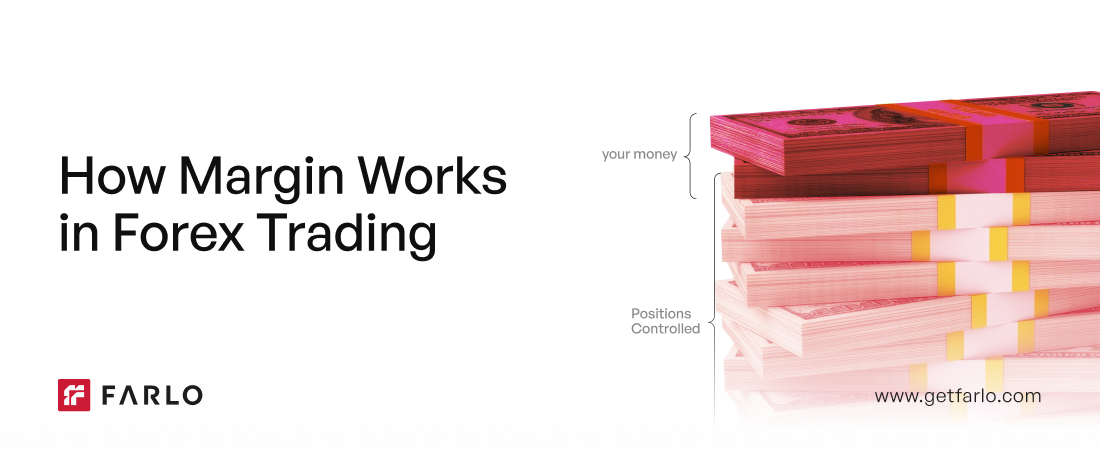
Forex margin is the amount of capital required to open and maintain a leveraged position.
When you trade with leverage, you do not need to provide the full value of the position as margin. Instead, a percentage of the position value is required.
- What is forex margin?
- How does margin work in forex trading?
- How to calculate forex margin
- Margin vs leverage: what’s the difference?
- How position size affects forex margin
- How margin works on Farlo
- Does higher leverage mean lower risk?
- Can you lose more than your margin?
- Margin vs forex trading costs
- Common forex margin mistakes
- How to manage margin risk
- Frequently Asked Questions about Forex Margin
For example, if you open a $100,000 position with a 1% margin requirement, the required margin is $1,000.
The position is still worth $100,000. The $1,000 is the amount required to support the leveraged position, not the maximum amount you can lose.
Margin is also different from trading costs such as spreads, commissions and swaps.
If you are new to forex, start with What Is Forex Trading? How Forex Trading Works. If you already understand the basics, this guide explains how margin works and how to calculate it.
How does margin work in forex trading?
Margin and leverage are directly related.
Leverage determines how much market exposure you can control relative to your available capital.
Margin determines how much capital is required to support that position.
The basic relationship is: Margin requirement = 1 ÷ leverage
For example:
| Leverage | Approximate margin requirement |
|---|---|
| 1:10 | 10% |
| 1:20 | 5% |
| 1:50 | 2% |
| 1:100 | 1% |
| 1:200 | 0.5% |
| 1:500 | 0.2% |
| 1:1000 | 0.1% |
These are mathematical relationships between leverage and margin. The actual leverage available depends on the instrument, account and applicable trading conditions.
Farlo’s current instrument specifications show maximum leverage of up to 1:1000 for Forex, 1:200 for Indices and Energies, and 1:20 for Crypto. Farlo Trading Instruments & Specifications
Maximum available leverage does not mean you need to use maximum leverage. Your position size and risk remain important.
For a detailed explanation of leverage, see What Is Leverage in Forex Trading?.
How to calculate forex margin
The basic formula is:
Required margin = Position value ÷ Leverage
Example 1: $100,000 position at 1:100 leverage
Position value: $100,000
Leverage: 1:100
Calculation: $100,000 ÷ 100 = $1,000
Required margin: $1,000
The position remains a $100,000 position. Using $1,000 of margin does not reduce the market exposure to $1,000.
Example 2: $50,000 position at 1:100 leverage
$50,000 ÷ 100 = $500
Required margin: $500
Example 3: The same position with different leverage
For a $50,000 position:
| Position value | Leverage | Required margin |
|---|---|---|
| $50,000 | 1:50 | $1,000 |
| $50,000 | 1:100 | $500 |
| $50,000 | 1:200 | $250 |
The position size stays the same. Changing the leverage changes the amount of margin required.
Margin vs leverage: what’s the difference?
Margin and leverage are related, but they are not the same thing.
| Margin | Leverage | |
|---|---|---|
| Definition | Capital required to support a leveraged position | Ratio between market exposure and required capital |
| Example | 1% margin | 1:100 leverage |
| Purpose | Determines the capital requirement | Determines the exposure available relative to capital |
A 1% margin requirement corresponds mathematically to 1:100 leverage.
The easiest way to remember the difference is:
Leverage describes the exposure. Margin describes the capital requirement for that exposure.
What is required margin?
Required margin is the amount of capital needed to open a specific position.
It depends on the position value and the applicable leverage or margin requirement.
For example, at 1:100 leverage:
- $10,000 position = $100 required margin
- $50,000 position = $500 required margin
- $100,000 position = $1,000 required margin
Larger positions require more margin when the leverage remains unchanged.
What is used margin?
Used margin is the amount of your account equity currently committed to open positions.
For example, if you have:
- Position 1 requiring $500 margin
- Position 2 requiring $300 margin
Your used margin is:
$500 + $300 = $800
Opening additional positions can increase your used margin and reduce your available free margin.
What is free margin?
Free margin is the amount of equity that is not currently being used as margin for open positions.
A simplified calculation is: Free margin = Equity − Used margin
For example:
Equity: $5,000
Used margin: $1,500
Free margin = $5,000 − $1,500 = $3,500
Free margin can change as the unrealised profit or loss on your open positions changes.
If your positions move against you, your equity can fall and your free margin can decrease.
What is margin level in forex?
Margin level measures your account equity relative to your used margin.
The commonly used formula is:
Margin level = Equity ÷ Used margin × 100
For example:
Equity: $5,000
Used margin: $1,000
$5,000 ÷ $1,000 × 100 = 500%
Your margin level is therefore 500%.
If equity falls to $2,000 while used margin remains $1,000:
$2,000 ÷ $1,000 × 100 = 200%
The margin level has fallen to 200%.
The applicable margin-call and liquidation thresholds depend on the trading provider, account and jurisdiction. Do not assume that a threshold published by another broker applies to Farlo.
What is a margin call?
A margin call occurs when the equity available in an account becomes insufficient relative to the margin required to maintain its open positions, based on the applicable trading conditions.
This can happen when open positions move significantly against the trader.
For example, if a trader has a large leveraged position and the market moves sharply against it, the resulting unrealised loss can reduce account equity and free margin.
Depending on the applicable terms, the trader may need to add funds or close positions.
The CFTC warns that leveraged OTC forex trading can result in substantial losses and explains that traders may be required to provide additional funds or close positions when losses reduce the funds available in the account. CFTC Forex Customer Advisory
What is a stop-out?
A stop-out is a mechanism that can automatically close open positions when an account reaches the applicable liquidation threshold.
The exact threshold and liquidation process depend on the trading provider and applicable account terms.
A stop-out is different from a stop-loss.
- Stop-loss: an order used to close an individual position at a specified price.
- Stop-out: an account-level mechanism related to insufficient margin.
For more on managing leveraged positions, read How to Trade Forex and CFDs Safely.
How position size affects forex margin
Position size directly affects the amount of margin required.
At 1:100 leverage:
| Position value | Required margin |
|---|---|
| $10,000 | $100 |
| $50,000 | $500 |
| $100,000 | $1,000 |
A larger position requires more margin.
More importantly, a larger position also creates greater market exposure. A lower margin requirement does not make a larger position less exposed to price movements.
For this reason, position size should be considered alongside leverage and available account equity.
How margin works on Farlo
The applicable leverage on Farlo depends on the instrument.
Farlo’s current instrument specifications include:
- Forex: up to 1:1000
- Indices: up to 1:200
- Energies: up to 1:200
- Metals: up to 1:1000
- Crypto: up to 1:20
The instrument specifications also provide information such as contract size, average spread, swap and trading hours. Farlo Trading Instruments & Specifications
For example, the published Standard-account specifications show a 100,000 contract size for EUR/USD and maximum leverage of 1:1000 for Forex.
Because leverage varies between instruments, you should check the applicable specifications for the instrument you intend to trade rather than applying the same margin calculation assumptions to every market.
Farlo’s Trade Hub also displays information such as margin requirements, liquidation level, spread, commission, financing and trading hours before order confirmation. Farlo Trade Hub
Does higher leverage mean lower risk?
No, higher leverage reduces the amount of capital required as margin for a given position. It does not reduce the position’s market exposure.
Consider a $100,000 position:
At 1:100 leverage
$100,000 ÷ 100 = $1,000 margin
At 1:500 leverage
$100,000 ÷ 500 = $200 margin
The position remains $100,000 in both cases.
The lower margin requirement does not mean the second position has lower market exposure.
The CFTC similarly warns that leverage can amplify both gains and losses in OTC forex trading. CFTC Forex Customer Advisory
Can you lose more than your margin?
Margin is not necessarily the maximum amount you can lose.
A leveraged position can generate losses that exceed the amount initially required as margin, depending on the product, provider, jurisdiction and applicable account protections.
Farlo’s instrument specifications warn that leveraged products carry significant risk and that traders could lose more than their initial deposit. Farlo Trading Instruments & Specifications
This is why margin should not be treated as a measure of the maximum risk of a trade.
Margin vs forex trading costs
Margin is different from the costs associated with executing and holding a trade.
Forex trading costs can include:
- Spread
- Commission
- Swap
- Slippage
Margin is the capital requirement associated with the leveraged position.
For example:
Position value: $50,000
Required margin: $500
Spread cost: $8
Commission: $7
Swap: $3
The $500 is the margin requirement. It is not a $500 trading expense.
The applicable trading costs in this example are the spread, commission and swap.
For a detailed breakdown of trading costs, read Forex Trading Costs: How Much Does It Really Cost to Trade?.
Common forex margin mistakes
1. Using maximum leverage because it is available
Maximum leverage determines the highest exposure-to-capital ratio available. It does not determine the appropriate position size for your account.
2. Treating margin as your maximum loss
Margin is a capital requirement, not a risk limit.
3. Ignoring position size
A small margin requirement can support a large market position. Always calculate the full exposure.
4. Assuming all instruments have the same margin requirement
Leverage varies across instruments. Check the current specifications for each market.
5. Ignoring free margin
Free margin changes as the equity in your account changes.
6. Forgetting trading costs
Spread, commission and swap can affect the profitability of a position even when sufficient margin is available.
7. Using margin without considering volatility
Highly volatile markets can move quickly enough to change account equity and margin levels in a short period.
How to manage margin risk
Before opening a leveraged position, check:
- Position size: How much market exposure are you taking?
- Leverage: What leverage applies to the position?
- Required margin: How much capital is required to open it?
- Free margin: How much equity will remain available?
- Potential loss: How much could the position lose if the market moves against you?
- Trading costs: What spread, commission and overnight costs may apply?
- Market volatility: How quickly could the instrument move?
These calculations should be completed before the position is opened, not after the market has moved.
Frequently Asked Questions about Forex Margin
Forex margin is the amount of capital required to open and maintain a leveraged position.
A simplified calculation is:
Required margin = Position value ÷ Leverage
For example, a $100,000 position at 1:100 leverage requires $1,000 of margin.
Leverage describes the relationship between market exposure and capital. Margin is the amount of capital required to support that exposure.
Free margin is the portion of account equity that is not currently being used as margin for open positions.
Used margin is the amount of account equity currently committed as margin for open positions.
Margin level measures equity relative to used margin.
Margin level = Equity ÷ Used margin × 100
No. Margin is a capital requirement for a leveraged position. Spread, commission and swap are examples of trading costs.
Not necessarily. Applicable leverage and margin requirements can vary by instrument, account and jurisdiction.
Check your margin before trading
Before opening a leveraged position, calculate the required margin and check how much free margin will remain in your account.
Then consider the full position size, potential loss, trading costs and market volatility.
On Farlo, you can review the current specifications for individual instruments, including leverage, contract size, spreads, swaps and trading hours, before trading. Farlo Trading Instruments & Specifications
If you’re continuing through Farlo’s Forex education series, read What Is Leverage in Forex Trading? and How to Trade Forex and CFDs Safely.
For the cost side of a trade, read Forex Trading Costs: How Much Does It Really Cost to Trade?.
Trading leveraged products involves significant risk and may not be suitable for all investors. You could lose more than your initial deposit. Trading conditions, leverage, spreads, swaps, commissions and margin requirements may change. Always review the current Farlo instrument specifications and applicable trading terms before trading.