
If you run a trading community, teach forex or post about the markets, people probably already ask you which broker you use. An introducing broker, or IB, turns those recommendations into a formal arrangement with a broker and gets paid when the traders they refer go on to trade.
The term gets used loosely, and partner programmes describe it in different ways. Before you sign up with any of them, it helps to know what an introducing broker actually does, how IBs are paid and where their responsibilities start and stop.
What Does an Introducing Broker Do?
An introducing broker refers clients to a broker. The broker opens and runs the client’s account, checks their identity, holds their money and executes their trades. The IB works before and around all of that, bringing traders in and often helping them get going.
In practice, most IBs do some mix of these:
- share a tracking link, so the broker knows which clients came from them
- show new traders how to register, verify and fund an account
- run education, such as lessons, webinars or a community chat
- answer questions in the client’s own language and time zone
An IB doesn’t hold client money and doesn’t place trades for clients. Managing other people’s accounts or telling them what to buy and sell is a different activity with its own rules, and most partner programmes don’t allow it.
How Introducing Brokers Are Paid
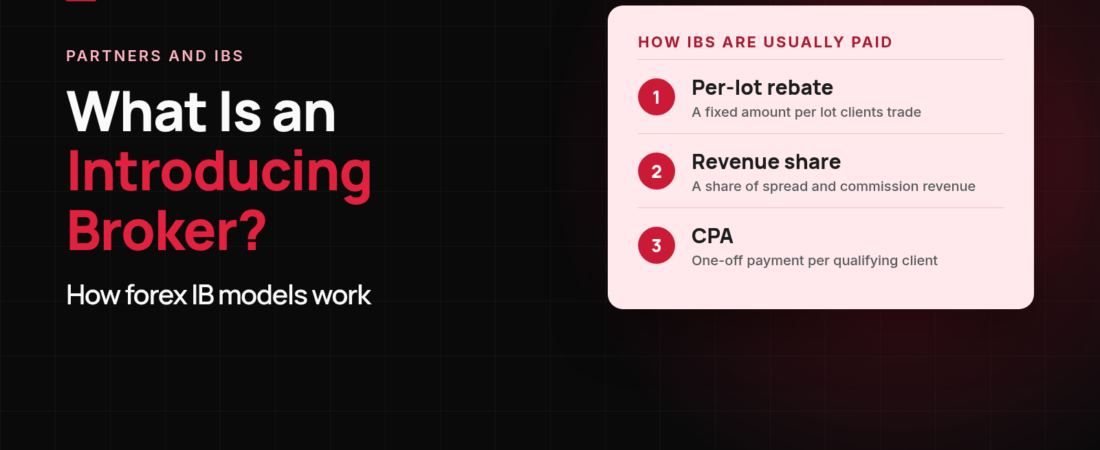
There are three common models in forex.
Per-lot rebates. The broker pays the IB a fixed amount for each lot their clients trade. This is the most common IB model, and it rewards ongoing activity rather than a one-off sign-up.
Revenue share. The IB receives a percentage of what the broker earns from the clients they referred, mainly from spreads and commissions.
CPA (cost per acquisition). A one-off payment for each new client who meets set conditions, such as making a first deposit. This is more typical of affiliates than IBs.
Some programmes add extras, such as monthly bonuses for hitting volume targets, or a smaller payment based on the earnings of other partners you bring in. That last one is often called a sub-IB or network override.
Introducing Broker vs Affiliate
The two overlap, and many programmes accept both. The usual difference is the relationship with the client. An affiliate tends to send traffic through a website, ads or reviews, and is often paid once per qualifying client. An IB usually knows their clients, supports them after they sign up and is paid on their trading over time.
Which model fits depends on how you reach people. A comparison website suits an affiliate deal. A forex teacher with a WhatsApp group of students is usually closer to an IB.
How Lots Are Counted
Because most IBs are paid per lot, it’s worth knowing how a lot is measured.
A lot is a standard trade size. On a standard forex account, 1.00 lot of EURUSD is 100,000 euros, so most retail traders trade fractions of a lot, such as 0.10 or 0.01. Our guide on how to calculate lot size and pip value explains the maths.
Many programmes count round-turn lots, meaning a position that has been opened and then closed. Ten trades of 0.10 lot, each opened and closed, add up to 1.00 round-turn lot.
Programmes also set rules on which volume counts. Trading funded by a bonus or credit, self-referrals and trades on unverified accounts are commonly excluded.
What Introducing Brokers Are Responsible For
Being an IB comes with duties to the people you refer, and brokers hold their partners to them.
- No promised returns. You can’t tell people they’ll make money, show “guaranteed” profits or suggest that following you will pay off.
- Risk warnings. Content that promotes leveraged products normally has to carry the broker’s risk warning.
- Disclosure. If you’re paid for referrals, your audience should know. A paid-partnership disclosure is standard.
- No signals or advice. Many programmes don’t let partners give trading signals or personal advice while promoting the broker.
- Local rules. Some countries regulate IB activity, and brokers can’t accept clients from restricted jurisdictions. Check the rules where you and your audience live.
How the IB Model Works at Farlo
We run one partner programme, open to creators, educators, community leaders, trading professionals and other eligible partners. You use the Farlo account you already have, activate partner access from the Partnership tab and share your tracking link. Our step-by-step guide on how to become a Farlo partner walks through the setup.
We use per-lot rebates, with two additions:
- Daily rebates of up to $25 per round-turn lot, fixed in US dollars by instrument and account type and credited every day on clients’ eligible trades.
- Monthly retainers across seven tiers, from $300 to $20,000, paid for the highest tier you reach in the month. Each tier has a Qualifying Lots target plus either an active-client or a new-funded-client target.
- A 10% network override on the rebates of partners who join through your link. We pay it on top, so they keep all of their own rebates.
Rates can change; check your partner dashboard for current terms.
Rebates, the override and retainers are paid into your Farlo Wallet. You need a verified Farlo account to withdraw.
Here’s a rebate at a small scale, using our Standard-account rate of $7 per lot on forex pairs.
This is an illustrative example only, not a promise of earnings.
| What happens | What you earn |
|---|---|
| A client you referred opens and closes 0.10 lot of EURUSD on a Standard account | $0.70 rebate |
| A partner who joined through your link earns a $0.70 rebate | $0.07 override, paid on top |
Retainers are earned on performance in each month. They are not a fixed salary or guaranteed income.
Only real, verified volume counts. Rebates apply to KYC-verified, funded live accounts. Volume funded by a bonus or credit doesn’t qualify, self-referrals, duplicate accounts and circular trading are excluded, and rebates on chargebacks or fraudulent activity are reversed.
We don’t onboard clients or partners from restricted jurisdictions, including the United States, Canada, Iran, North Korea, Syria, Cuba, Russia, Pakistan, Iraq and any FATF blacklisted jurisdiction. The full list is in the Partner Terms.
Frequently Asked Questions
IB stands for introducing broker. It’s a person or business that refers traders to a broker and is usually paid a rebate on the lots those traders trade.
No. The broker runs the client’s account, holds their funds and executes their trades. An introducing broker refers clients and often supports them, but doesn’t handle their money or trade for them.
A rebate is a fixed amount a broker pays an IB for each lot their referred clients trade. Our rebates are set in US dollars per round-turn lot by instrument and account type, and credited daily.
Not always, but your clients will ask you questions, so you should understand the products, the platform and the risks. You also have to follow the broker’s marketing rules, including risk warnings and never promising returns.
No. What an IB earns depends on their clients’ real trading, which can rise, fall or stop. We pay IB earnings only from genuine client trading, never from sign-ups or recruiting alone.
If you’re ready to set up partner access, follow our guide on how to become a Farlo partner, and check current rates and Partner Terms in your partner dashboard.
Trading involves risk. CFDs are leveraged products and can result in significant losses. Product availability depends on your country. This article is for informational purposes only and does not constitute financial advice.