
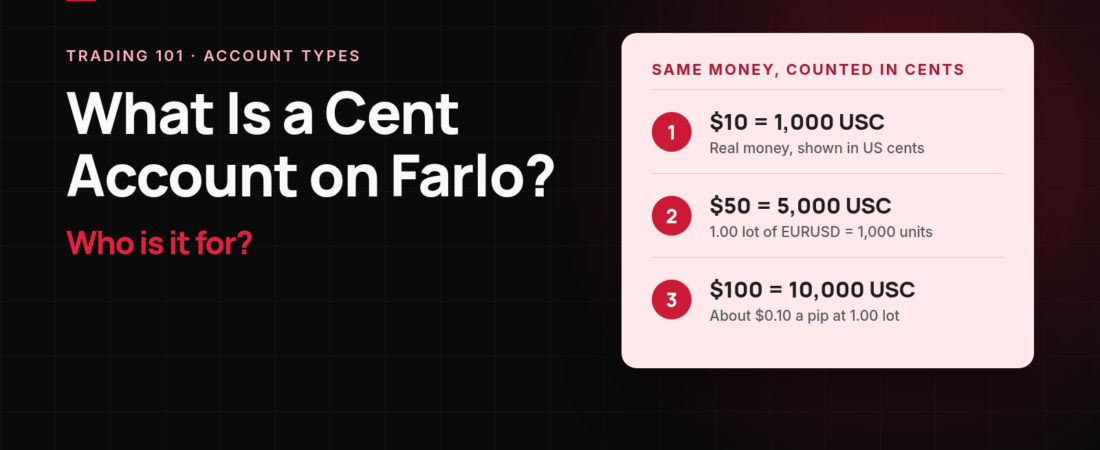
A cent account is a live trading account where everything is counted in US cents instead of dollars, and each lot is 100 times smaller than on a standard account. You trade real money, on real prices, but in amounts small enough that a mistake costs cents rather than dollars.
This guide explains how a cent account works, what a cent lot is worth, what it does and doesn’t change about your costs and risk, and when it makes sense to move up to a Standard account.
How a Cent Account Works
Two things are different on a cent account: how your balance is shown, and how big one lot is.
Your balance is shown in US cents (USC). One dollar is 100 cents, so a $50 deposit appears as 5,000 USC. Nothing has been added. It’s the same $50, counted in smaller units.
Each lot is 100 times smaller. On a Standard account, 1.00 lot of EURUSD is 100,000 euros. On a Farlo Cent account, 1.00 lot is 1,000 euros.
Because both change by the same factor, the numbers on your screen look bigger while the money at risk gets smaller. That’s the whole idea.
Cent Account Lot Size, in Dollars
This is where most of the confusion comes from, so here it is side by side for EURUSD:
| Lot size | Standard: units | Standard: value of 1 pip | Cent: units | Cent: value of 1 pip |
|---|---|---|---|---|
| 1.00 | 100,000 | $10 | 1,000 | $0.10 |
| 0.10 | 10,000 | $1 | 100 | $0.01 |
| 0.01 | 1,000 | $0.10 | 10 | $0.001 |
So 1.00 lot on a Cent account moves the same amount as 0.01 lot on Standard. The smallest trade on Standard is the biggest round number on Cent.
Gold works the same way. On Farlo, 1.00 lot of XAUUSD is 100 ounces on Standard and 1 ounce on Cent. On Cent, 1.00 lot gains or loses $1 for every $1 gold moves, and 0.10 lot gains or loses $0.10.
Cent symbols on Farlo end in .c, so you’ll see EURUSD.c or XAUUSD.c in MT5. If you want the full method for sizing a trade, our guide on how to calculate lot size and pip value works through it step by step.
Why Cent Accounts Exist
Most traders are told to risk 1% or 2% of their balance on a trade. On a small balance, that’s hard to do on a Standard account.
Take a $50 account and a 20-pip stop-loss on EURUSD. 1% of $50 is $0.50.
| Standard | Cent | |
|---|---|---|
| Trade size | 0.01 lot (the smallest available) | 0.25 lot |
| Money at risk on a 20-pip stop | $2.00 | $0.50 |
| Share of a $50 balance | 4% | 1% |
On Standard, 4% is as small as it gets. On Cent, you can size the trade to your rule. That’s the main reason cent accounts exist: they let a small balance follow the same risk habits a large one would.
Our guide to trading with a small account goes further into risk per trade and what a small account can realistically do.
Cent vs Standard Account: What Stays the Same
A cent account isn’t a different kind of market. On Farlo, Cent has the same conditions as Standard:
| Standard | Cent | |
|---|---|---|
| 1.00 lot of EURUSD | 100,000 units | 1,000 units |
| 1.00 lot of gold | 100 ounces | 1 ounce |
| Balance shown in | US dollars | US cents (USC) |
| Commission | None | None |
| Average EURUSD spread | 17 points | 17 points |
| Average gold spread | 28 points | 28 points |
| Maximum leverage on forex and gold | Up to 1:1000 | Up to 1:1000 |
| Instruments | 44 | 32 |
The spread is the same in points, which means the cost is the same share of each trade. A 1.7-pip spread costs $0.17 on 1.00 Cent lot of EURUSD, and $0.17 on 0.01 Standard lot. Cent doesn’t make trading cheaper. It makes each trade smaller.
The leverage available to you on any account can depend on your balance and your country.
What a Cent Account Doesn’t Do
A cent account can feel safer than it is. Keep these limits in mind.
- It doesn’t lower your risk on its own. Losing 2,500 USC is still half of a $50 balance. If you trade 5.00 lots on Cent because the number feels small, you’re risking as much as 0.05 lot on Standard.
- It doesn’t cover every market. Farlo’s Cent account has 32 instruments: 28 forex pairs, gold, silver, Brent and WTI. Indices and crypto aren’t on it, so US30 or BTCUSD need a Standard or Pro account.
- It isn’t a demo. The money is real and so are the losses. A demo account, with virtual funds, is still the better place to learn where the buttons are.
- Big numbers can mislead you. A balance of 10,000 USC is $100. Seeing “+300” after a good day is $3. Keep the dollar figure in your head, or it’s easy to take bigger risks than you meant to.
Who a Cent Account Is For
| If you… | A cent account helps because |
|---|---|
| Are moving from demo to real money | You feel real spreads and real nerves at a size where mistakes are cheap |
| Have a small balance | You can follow a 1% or 2% risk rule instead of risking 4% or more per trade |
| Want to test a new strategy or Expert Advisor | You get real execution without committing a full-size account |
| Mainly trade forex, gold, silver or oil | Those are the markets the Cent account carries |
It’s probably not for you if you mainly trade indices or crypto, or if your balance is already large enough to size trades properly on Standard. Our guide to Farlo account types compares Standard, Cent and Pro if you’re still deciding.
Comparing Cent Account Brokers
Many brokers offer some form of cent or micro account, and they don’t all work the same way. If you’re comparing, check:
- Contract size. Is the lot really 100 times smaller, or just a different minimum trade?
- Spreads against the standard account. Some brokers charge wider spreads on cent accounts. On Farlo, average spreads on Cent match Standard.
- Which markets are included. Many cent accounts are forex-only.
- Whether you can move up later without closing everything and starting again.
- Whether it’s offered where you live. Account types and leverage vary by country.
When to Move Up to Standard
A simple test: can you follow your risk rule on Standard with your usual stop-loss?
At 0.01 lot of EURUSD on Standard, a 20-pip stop risks $2. If 1% of your balance is at least $2, which means a balance of $200 or more, the smallest Standard trade fits your rule. Below that, Cent gives you more room to size trades properly.
Your results matter too. Move up when you’ve been following your plan consistently for a while, not after one good week. You don’t have to close the Cent account to do it. You can hold more than one Farlo trading account, each with its own MT5 login, and the Farlo Wallet guide shows how moving money between your wallets and accounts works.
How to Open a Cent Account on Farlo
- If you’re new, register on Farlo and complete identity verification.
- Log in to your Farlo account and go to Accounts.
- Open a new trading account and choose Cent, if it’s available in your country.
- Fund it from your Main Wallet. Your balance will show in USC.
- Log in to MT5 with the new account’s details. The server is FarloMarkets-Server. Our guide to connecting Farlo to MetaTrader 5 walks through it.
Frequently Asked Questions
Yes. A cent account is a live account with real deposits, real prices and real profits or losses. The balance is shown in US cents, so $20 appears as 2,000 USC, but the money behind it is the same.
On Farlo’s Cent account, 0.01 lot of EURUSD is 10 euros, and each pip is worth about $0.001. That’s 100 times smaller than 0.01 lot on a Standard account, where each pip is worth about $0.10.
It’s a good second step. Start on a free demo account to learn the platform, then use a cent account to trade real money in small sizes. It won’t stop you losing money if you oversize your trades, so keep a stop-loss on every trade.
Yes. On Farlo, the Cent account includes gold (XAUUSD.c) and silver (XAGUSD.c). 1.00 lot of gold on Cent is 1 ounce, so a $1 move in the gold price is worth $1 at 1.00 lot.
You can open a Standard or Pro account alongside your Cent account rather than converting it. Each account has its own balance and MT5 login, so you can keep the Cent account for testing ideas.
A cent account is a sensible bridge between demo and full-size trading, as long as you treat the cents as real money. Log in to Farlo, practise on demo first, and open a Cent account where available when you’re ready to trade small.
Trading involves risk. CFDs are leveraged products and can result in significant losses. Product availability depends on your country. This article is for informational purposes only and does not constitute financial advice.