
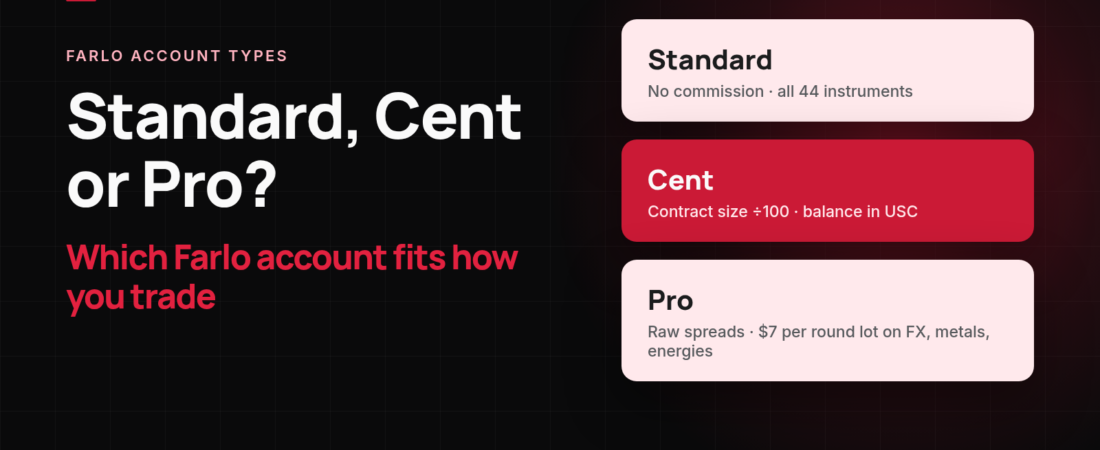
You’ve registered, your documents are in, and Farlo is asking which trading account you want to open. There are three real-money Farlo account types, Standard, Cent and Pro, plus a demo account. The choice isn’t permanent, but it changes what each pip is worth, how you pay for each trade and which markets you can reach.
This guide is about choosing. If you want the full cost maths, our guide to forex trading costs goes through spread, commission and swap in detail.
Farlo Account Types Side by Side
These figures come from Farlo’s instrument specifications.
| Standard | Cent | Pro | |
|---|---|---|---|
| Instruments | 44 | 32 | 44 |
| 1.00 lot of EURUSD | 100,000 units | 1,000 units | 100,000 units |
| 1.00 lot of gold | 100 ounces | 1 ounce | 100 ounces |
| Commission | None | None | $7 per round lot on forex, metals and energies |
| Average EURUSD spread | 17 points | 17 points | 1 point |
| Average gold spread | 28 points | 28 points | 12 points |
| Indices and crypto | Yes | No | Yes (no commission) |
On EURUSD, 10 points make 1 pip, so 17 points is 1.7 pips. Spreads are averages under normal conditions. They can widen when liquidity is thin or big news hits.
Maximum leverage is the same on all three. It goes up to 1:1000 on forex and metals, 1:200 on indices and energies, and 1:20 on crypto. The leverage you actually get can also depend on your balance and your country.
Standard: Simple Pricing, Every Market
Standard is commission-free. Farlo builds its costs into the spread, so the gap between the buy and sell price is the whole cost of opening a trade (plus swap if you hold overnight). You can see that cost on the screen before you tap Buy or Sell.
You get all 44 instruments: 28 forex pairs, gold and silver, Brent and WTI oil, five indices including US500 and US100, and seven cryptocurrencies including BTCUSD. Lot sizes are standard too: 100,000 units on forex and 100 ounces on gold.
The trade-off is a wider spread than Pro on forex, metals and energies. At the published averages, a 0.10 lot EURUSD trade costs about $1.70 in spread on Standard.
Standard suits you if you trade a mix of markets, trade a few times a week rather than many times a day, and would rather think about one cost than two.
Cent: Real Money, Smaller Steps
The Cent account has the same conditions as Standard, with no commission and almost identical average spreads. The difference is the contract size, which is divided by 100. One lot of EURUSD on Cent is 1,000 units instead of 100,000.
Your balance is shown in US cents (USC). Deposit $50 and your account shows 5,000 USC. That can look like more money than it is, so keep the dollar figure in your head.
Here’s why it matters. The smallest trade on a Standard account, 0.01 lot of EURUSD, moves $0.10 per pip. On Cent, 0.01 lot moves $0.001 per pip and a full 1.00 lot moves $0.10. With a small balance, that’s the difference between guessing at your position size and sizing every trade properly. Our guide on how to calculate lot size works through a $50 example on Cent.
Cent also suits traders testing a new strategy with real money and real execution, at a size where mistakes are cheap.
There are limits. Cent has 32 instruments: the 28 forex pairs, gold, silver, Brent and WTI. There are no indices and no crypto. And smaller numbers don’t mean lower risk in proportion to your account. Losing 2,500 USC is still half of a $50 balance.
Pro: Tighter Spreads, Plus a Commission
Pro uses raw spreads with a commission of $7 per round lot on forex, metals and energies. A round lot is 1.00 lot opened and closed, so a 0.10 lot round trip costs $0.70 in commission.
The spreads are much tighter. Farlo’s published averages put EURUSD at 1 point on Pro against 17 on Standard, and gold at 12 points against 28.
To compare the two, add the spread and commission together. For 1.00 lot of EURUSD at the published averages:
| Account | Spread | Commission | Total |
|---|---|---|---|
| Standard | 17 points = $17 | $0 | $17 |
| Pro | 1 point = $1 | $7 | $8 |
Those are averages, and the real spread at the moment you trade will differ. But the gap is wide enough that if you trade forex or gold often, or at larger sizes, Pro is worth a serious look. Scalpers who open and close many trades a day feel this difference most.
One thing people miss: on indices and crypto, Pro’s published spreads are the same as Standard’s, and neither account charges commission on them. If you mainly trade US100 or BTCUSD, Pro doesn’t change your costs.
Which Account Fits You
| If you… | Look at | Because |
|---|---|---|
| Are starting with a small balance | Cent | You can size trades properly with very little money |
| Want to test a strategy with real money | Cent | Real execution at a fraction of the size |
| Trade a mix of forex, gold, indices and crypto | Standard | All 44 instruments and one cost to think about |
| Trade forex or gold many times a day | Pro | Tighter spreads and a fixed commission |
| Trade gold in larger sizes | Pro | Gold averages 12 points on Pro against 28 on Standard (add the $7 commission when you compare) |
| Mainly trade indices or crypto | Standard or Pro | Costs are the same on both, and Cent doesn’t offer them |
| Haven’t placed a trade yet | Demo | Practise with virtual funds first |
If two rows describe you, go with the one that matches how you’ll trade most of the time.
Start With Demo if You’re New
A demo account uses live prices and virtual money. It’s the place to learn MT5, practise placing a stop-loss and work out lot sizes before anything is at stake. You can open one from your Farlo dashboard, and our guide to connecting Farlo to MetaTrader 5 shows you how to log in to it.
When you move to a live account, start smaller than you think you need to. A demo account doesn’t prepare you for how it feels to watch real money move.
Swap-Free and Islamic Accounts
Farlo lists Islamic accounts, which trade under Sharia-compliant conditions with zero swaps, on its trading conditions page. If you need a swap-free account for religious reasons, contact Farlo before you open your account to ask about eligibility in your country.
Swap-free doesn’t mean free. You still pay the spread, and on Pro, the commission.
Can You Change Your Mind Later?
Yes. You can hold more than one Farlo trading account, and each one has its own MT5 login. If you start on Cent and outgrow it, you can open a Standard or Pro account alongside it.
Not every account type, leverage level or instrument is available in every country. What you can open depends on where you live and your eligibility. The terms that apply to you are shown during onboarding and inside your account.
Frequently Asked Questions
Yes. It’s a live account with real deposits and real trades. The balance is shown in US cents, so $1 appears as 100 USC, but the money behind it is the same.
Yes. You might keep a Cent account for testing ideas and a Standard or Pro account for your main trading. Each account has its own MT5 login and its own balance.
No. Farlo publishes the same maximum leverage for each asset class across Standard, Cent and Pro. What changes on Pro is how you pay for trades, not how much margin they need.
They tell you which account type the contract belongs to. In Farlo’s specifications, Cent symbols end in .c (EURUSD.c) and Pro symbols end in .pro (EURUSD.pro). Standard symbols have no suffix.
If you haven’t registered yet, our step-by-step registration guide takes a few minutes to follow. Once you’re verified, log in to Farlo, go to Accounts and open the account that fits how you trade.
Trading involves risk. CFDs are leveraged products and can result in significant losses. This article is for informational purposes only and does not constitute financial advice.