
A lot of people come to trading through someone else’s results. A friend shares a screenshot in a Telegram group, or a trader online posts a month of winning days, and the next thought is to let that person’s trades run on your own account. Copy trading lets you do that.
For beginners, copy trading can look like a way to skip the hard part of learning to trade. It can be a sensible place to start, but only if you understand what you’re handing over and what stays in your control. Most of the problems new copy traders run into come from the second part.
What Is Copy Trading?
Copy trading links your account to a strategy run by another trader, usually called a strategy provider. When the provider opens a trade, a matching trade opens on your account, and when they close it, yours closes too. You don’t pick the entries or the exits. You pick who to follow, how much money to put behind them and when to stop.
The copied trade is usually scaled to the money you allocate, not to the size of the provider’s account.
This example is hypothetical. It isn’t a Farlo strategy or a real result.
| Strategy provider | You | |
|---|---|---|
| Money in the strategy | $10,000 | $100 |
| Trade opened | 1.00 lot EURUSD | 0.01 lot EURUSD |
| Price moves 10 pips in the trade’s favour | +$100 | +$1 |
| Price moves 10 pips against the trade | -$100 | -$1 |
In real accounts the scaling isn’t always this neat. The smallest trade on most accounts is 0.01 lot, so with a very small allocation a copied trade may be rounded, which can mean more risk than you planned, or it may not copy at all. If you’re unsure how lot sizes turn into money, our guide on how to calculate lot size and pip value shows the maths.
Copy trading is also different from PAMM-style accounts, where money from several investors is pooled and traded as one account. Our Trade hub lists both.
How Copy Trading Works on Farlo
Copy trading is part of Farlo Trade, alongside CFD trading on MetaTrader 5. On our Copy, Social & Advanced page, you can explore strategy providers, copy eligible strategies and review their public performance.
Each strategy shows its history, risk score, drawdown, trading frequency, the assets it trades, its fees and its follower count. You can also set limits on your copied trades before you follow anyone, and we’d strongly suggest you do.
There’s a social side as well. You can follow assets, traders, watchlists, market themes and educational posts, which is a good way to see how a provider explains their trades before you put money behind them.
Copy trading and other advanced products are only offered where approved. What you can access depends on your country and your eligibility.
What to Check Before You Follow a Strategy
The strategy page gives you the numbers, but they only help if you know what each one is telling you.
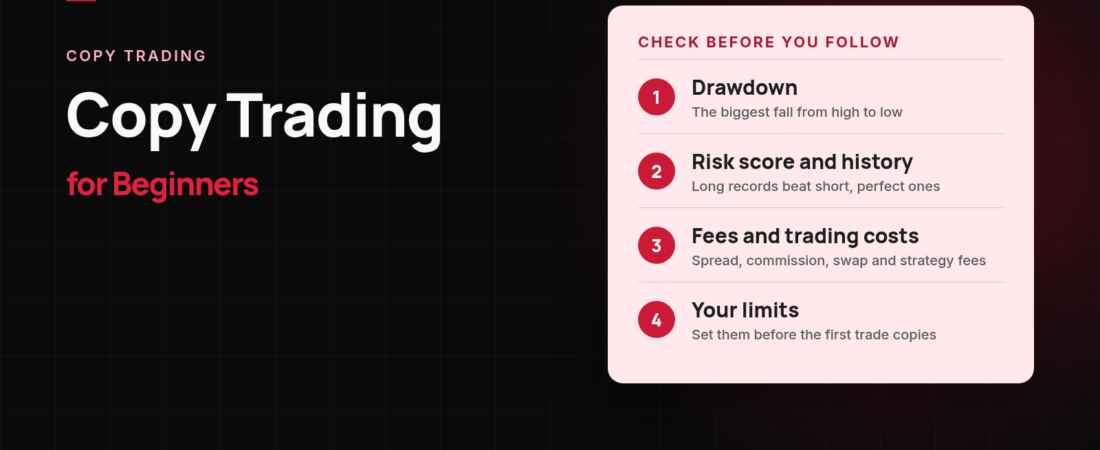
- Drawdown. The biggest fall the strategy has had from a high point to a low point. If it once dropped 40%, assume it can happen again, and think about how you’d feel watching $100 turn into $60.
- Risk score. A quick read on how aggressive the strategy is. Look at it next to drawdown rather than on its own.
- History. Two good months tell you very little. A longer record that includes some losing months is often more honest than a short, perfect one.
- Trading frequency. A provider who trades many times a day pays the spread many times a day, and so do you.
- Assets traded. Gold, indices and crypto can move much further in a day than major forex pairs. Make sure you’re comfortable with what the provider actually trades.
- Fees. Check how the provider is paid before you follow, not after your first month.
- Followers. A big following shows a strategy is popular. It doesn’t show it’s safe.
What Copy Trading Costs
You pay on two levels. The first is the normal cost of every copied trade: the spread, commission if your account charges it, and swap if a trade stays open overnight. These work the same way as on trades you place yourself, and Forex Trading Costs explains each one.
The second is what the strategy charges. We show fees on each strategy, and they differ from one provider to another. A common model across the industry is a performance fee, where the provider takes a share of the profit the strategy makes for you.
The figures below are hypothetical and only show how a performance fee works. They aren’t Farlo’s fees or any provider’s real results.
Say you put $50 behind a strategy with a 20% performance fee, and it makes $2 for you in a month. The fee is $0.40 and you keep $1.60. If the strategy loses $2 instead, a performance fee usually isn’t charged, but the $2 loss is still yours, along with the spread on every trade it opened.
Small costs weigh more on small allocations. A strategy that trades all day can run up enough in spreads to wipe out most of what a $50 copy makes.
What Can Go Wrong With Copy Trading
Past performance does not guarantee future results, and copy trading can result in losses. A strategy’s history shows how it handled the markets it has already traded. It can’t tell you what happens next.
Your results won’t match the provider’s exactly. Copied trades open a moment after the provider’s, so your price can be slightly different. This is called slippage. Add your own spreads, fees and rounding on small sizes, and your returns can sit below the provider’s even when every trade copies.
Providers change how they trade. Someone who did well with small, careful positions can start taking bigger risks after a losing run, or move into markets they know less well. Look at the strategies you follow every week or so, not only on the day you start.
Leverage works against you as well as for you. CFDs are leveraged products, so a copied trade can take a bigger bite out of your allocation than the price move suggests. If leverage is new to you, read What Is Leverage in Forex Trading? first.
High recent returns usually come with high risk. Strategies that had a huge month attract followers fast, and the same approach that made 50% in one month can lose 50% in the next.
Stopping doesn’t undo losses. When you stop copying a strategy, check what happens to any trades that are still open, and remember that losses already taken stay on your account.
How to Start Copy Trading Carefully
- Learn the basics. You don’t have to place your own trades, but you should know what a lot, a pip and a stop-loss are.
- Spend some time on a free demo account. It uses virtual money, so you can watch how trades open, move and close with nothing at stake. Our guide to connecting Farlo to MetaTrader 5 shows you how to log in to one.
- Decide on an amount you could lose completely without it touching your rent or bills, and start with less than that.
- Compare a few strategies and follow one. Splitting a small balance across several strategies makes each copy tiny and harder to scale properly.
- Set your limits before the first trade copies. Decide the most you’re prepared to lose on the strategy and set that limit before you follow.
- Review the strategy every week. If it starts trading very differently from when you joined, you can stop copying.
Your account type affects what each copied trade costs, so it’s worth reading Standard, Cent or Pro before you fund. For general habits that keep risk under control, see How to Trade Forex and CFDs Safely.
Frequently Asked Questions
It means linking your account to another trader’s strategy so their trades open and close on your account automatically, scaled to the money you allocate. You decide who to follow, how much to put in and when to stop.
It carries the same risks as trading yourself, because the trades are real and leveraged, and a provider’s past results don’t guarantee future ones. Starting with a small amount, choosing strategies with moderate drawdowns and setting limits before you follow all help keep the risk in proportion.
It depends on the strategy and your account. Very small amounts can be hard to scale, because copied trades still have a minimum size. Whatever you start with should be money you can afford to lose.
We offer copy trading only where approved, so it depends on your country and eligibility. Log in to your account to see what’s available to you, or contact our support team to ask.
Yes. Every copied trade carries the normal trading costs, the spread, any commission and overnight swap, plus whatever fee the strategy charges. We show a strategy’s fees on its page before you follow it.
If you’re new to trading, open a free demo account from your Farlo dashboard first. When you’re ready, explore strategy providers on our Copy, Social & Advanced page and set your limits before you follow anyone.
Trading involves risk. CFDs are leveraged products and can result in significant losses. Product availability depends on your country. This article is for informational purposes only and does not constitute financial advice.